Commercial development across dense urban corridors like Brickell, Edgewater, and the Design District demands strict control over site perimeters and staging footprints. When ground space is constrained between active…
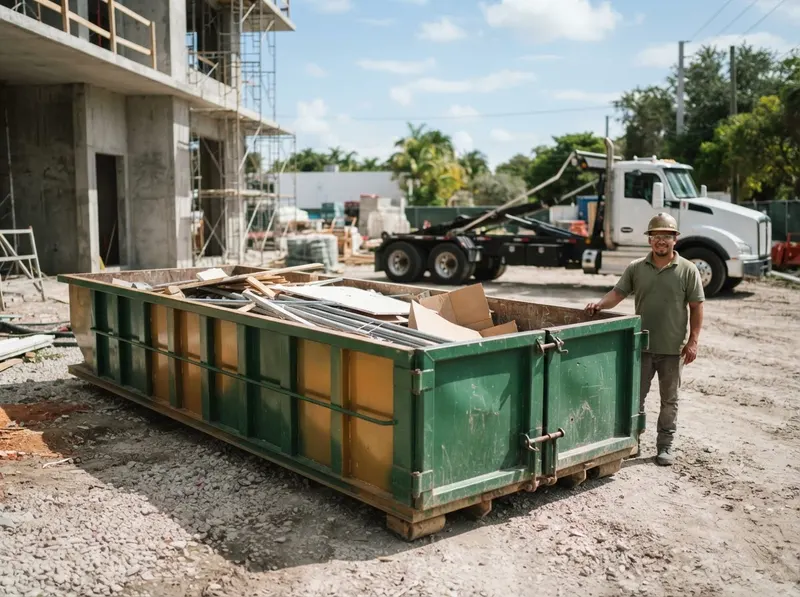
Commercial development across dense urban corridors like Brickell, Edgewater, and the Design District demands strict control over site perimeters and staging footprints. When ground space is constrained between active travel lanes and tight lot lines, unmanaged rubble creates safety hazards and prompts local code citations. GreenRoute Waste Removal coordinates roll-off delivery schedules directly with site superintendents, ensuring containers arrive during precise staging windows so interior demolition crews load materials directly into bins rather than double-handling debris onto loading docks or parking pads. Roll-off drivers deploy heavy timber blocking beneath steel rollers on every commercial placement to prevent asphalt rutting, concrete spalling, and curb scraping.
Selecting container volume depends on material density and loading footprints. Compact commercial fit-outs in historic corridors like Little Havana, Coral Way, or Coconut Grove often require lower-profile bins due to narrow alley clearances or tree canopies. A 10-yard container suits dense, non-compactable materials such as ceramic tile or concrete trench cutouts, holding roughly 4 pickup-truck loads without exceeding road-safety thresholds monitored by the Federal Motor Carrier Safety Administration. For full-floor tenant improvements in Wynwood or multi-story builds along Overtown and Allapattah, 30-yard and 40-yard roll-offs hold between 12 and 16 pickup loads of light-to-medium demolition waste like steel studs, HVAC ducting, and insulation.
Environmental accountability remains central to ongoing project compliance. Recyclable materials must be routed efficiently according to standards established by the Environmental Protection Agency and regulated at the state level by the Florida Department of Environmental Protection. Construction debris is diverted through certified sorting processors in accordance with guidelines from the U.S. Green Building Council to support LEED recycling documentation. Managing structural and interior debris properly aligns with federal jobsite safety protocols outlined by the Occupational Safety and Health Administration, while road transit adheres to transport rules from the Florida Department of Transportation.
Project operations also intersect with local municipal oversight. Commercial placements near pedestrian thoroughfares require adherence to municipal safety guidelines overseen by the City of Miami and regional environmental directives administered through Miami-Dade County. Recyclable metals and salvageable structural elements are managed in alignment with standard diversion practices defined by the Construction and Demolition Recycling Association and the overarching environmental frameworks curated by Earth911. For straightforward billing without surprise delivery or disposal surcharges, contractors call (786) 947-6450 to stage equipment.
Every job gets a firm, written price after a free on-site visit.
For standards, safe disposal, and service guidance on DUMPSTER in Miam, FL, useful references include U.S. EPA, EPA, EPA, OSHA, Earth911, and Google Maps. General consumer and small-business resources are available from USA.gov, Better Business Bureau, FTC Consumer Advice, U.S. Small Business Administration, and Ready.gov.
Tell us about your commercial construction roll-off management job in Miam and we'll send a clear, written quote, usually the same day.
 GreenRoute Waste Removal